
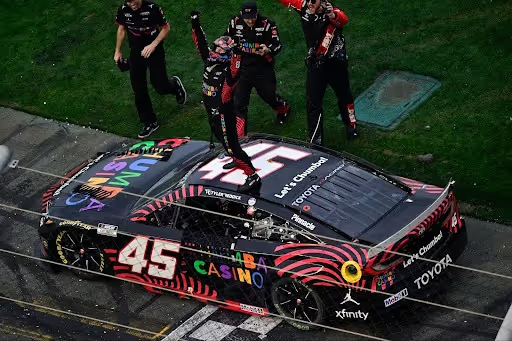
If winning the Daytona 500 changes your life, it apparently starts with your face.
Tyler Reddick’s Daytona 500 victory was scant seconds old and already his eyes, wet with tears, bulged inside his helmet. His face, pink with exertion and emotion, radiated joy.
Neither his eyes nor his face betrayed any doubt about the outcome. His brain, though, wanted to tap the brakes. Reddick didn’t want to celebrate yet. Not until it was official. Who can blame him? His life was about to start a new chapter — and so was NASCAR’s — so he wanted to be sure he was right. He worried he had missed something — and indeed there was a lot to miss in the crazy final lap — and maybe the caution had come out, and he didn’t know it.
Three times, he hit his microphone.
Three times, he asked his crew if he had won.
Three times, he was met with silence.
Where the hell was his team?
“I think they were trying to (answer),” he says. “But everyone was losing their mind.”
As well they should.
The final lap of the 2026 Daytona 500 was as chaotic as they come.
The driver who led when the white flag fell, Carson Hocevar, wrecked and finished 18th. Chase Elliott held the lead coming off Turn 4 on the final lap — the sport rose to its collective feet as NASCAR’s favorite son barreled toward his signature win! — but he got lightly doored by Reddick, then wrecked and finished fourth. The third-place car, driven by Joey Logano, crossed the finish line perpendicular to the oncoming field, which normally would be straight terrifying, though by that time just about everybody was either wrecked or wrecking, so maybe it wasn’t so bad.
It’s funny to look back at one of the big questions heading into this race — whether the end of the “win-and-you’re-in” era of the playoffs would change the way drivers approach the ends of races. Maybe, one line of reasoning went, if you take away that outsized incentive, drivers will be more conservative and not wreck so dang much on the final lap.
(Laughs hysterically)
There was zero evidence of that.
When Reddick exited his No. 45 car and hugged Michael Jordan — his team’s co-owner and the most famous and popular athlete in history — after leading only a few hundred yards of the race, the rough equivalent of a halfcourt buzzer beater, it became the latest addition to Daytona International Speedway’s long run of “perfect-storyline days” that would seem made up if they didn’t happen on live TV and weren’t witnessed by several hundred thousand people.
That list includes the 1979 Daytona 500 being the first broadcast in its entirety and ending in a fight as a snowed-in Eastern seaboard TV audience watched with their collective mouths agape, Richard Petty getting his 200th win with President Ronald Reagan in attendance and Dale Earnhardt Jr. winning the first race at Daytona after his dad died there on the final lap of the 2001 Daytona 500.
Reddick’s mad dash to the checkered flag, his hug of Jordan, his heartfelt embrace of his son amid the celebration, is a story worth telling today, tomorrow and for years to come for the joy of the driver, the joy of the owner and the joy of a good story.
The joy of tension
Or really, the joy of many good stories.
The day overflowed with storylines. Connor Zilisch, the 19-year-old phenom, ran his first Daytona 500. He started next to 50-year-old Jimmie Johnson, the seven-time champion who is Zilisch’s racing hero and was competing in his next-to-last Daytona 500.
Bubba Wallace, Reddick’s teammate who has twice finished second in this race, led a race-high 40 laps, and later said it was the best Daytona 500 he had ever run. He finished 10th. Brad Keselowski, owner and driver of the No. 6 Ford, limped around the track with a cane after breaking his femur in the offseason. He had a sliver of a chance to win until he wrecked with the finish line in sight.
Yes, the 68th running of the Great American Race even had something for detractors, in particular stretches where the entire field appeared to be in fuel savings mode. That meant cars lined up three wide for 10 rows deep for lap after lap. Someone asked Reddick’s crew chief after the race whether that’s fixable. A better question would be, why do we want to fix that? Do we really not want 30 cars to be within a second of each other, as they were for several stretches?
Critics have a point — drivers running at less than full throttle in the biggest race of the year makes it seem like it’s not actually the biggest race of the year. Those critics think that’s boring because we’re waiting for something to happen.
But maybe we should think about it differently. What we’ve lost in speed we’ve made up for in tension. The tension of waiting for something to give as the cars barrel through turn after turn inches from each other on every side.
When 30 cars race three wide for 10 rows deep, everybody has to behave. Everybody has to stay in line. Everybody has to play along. Everybody has to submit their own desires to the good of the group.
Does that sound like something NASCAR drivers will do?
Not for long.
And full throttle or not, the suspense as we wait for someone, anyone, to break the system is Hitchcockian.
Who will step out of line? Who will push for more speed from the middle of the pack? Who will get impatient and say enough of this? That person becomes a villain to his fellow drivers and a hero to fans.
‘What’s going to be in this chapter?’
All week, optimism permeated the NASCAR world. Hope had arrived anew. That’s true every year at Daytona, but especially so this year. You could see it on social media, hear it in driver’s comments, sense it as you jostled cheek to cheek on the grid before the sold-out race with the biggest purse in its history.
“There’s been so much that has gone on,” Johnson says. “Our sport has seen some headwinds in the last four to six months. To have that all behind us now and have the biggest race of the year kick off our season, it’s the perfect thing. It’s the right medicine for us.”
This was more than just the first race of a new season, more than a pivot, more than a reset.
It felt like the first race in the rest of NASCAR’s life.
Or as Jordan put it: “This is a whole new beginning.”
And a much-needed one at that.
Keselowski has a shelf full of NASCAR season yearbook magazines at home. They recap the season that just ended and look ahead to the season to come. “When you flip through them, some of the seasons just blah together,” he says. “Like, oh, that was a different season?”
Every now and then — like this season — a big change happens, and NASCAR enters a new chapter.
As last season concluded with a thoroughly unsatisfying end of the final race (which managed to make a worthy champion in Kyle Larson seem less so and will be remembered as a muted finale to the playoffs era), the lawsuit between two teams (and led by 23XI Racing, the team that Jordan started with Denny Hamlin five years ago) and NASCAR that ended in a settlement, and NASCAR commissioner Steve Phelps resigned, it was clear NASCAR needed to jolt itself out of its doldrums.
That jolt came in the form of a “new” points system. Gone is the win and you’re in, elimination-style system. In its place is a return to The Chase in which the season is broken up into 26 regular-season races and a 10-race Chase.
“I think all of the industry is looking forward to having an historic year,” says Christopher Bell, driver of the No. 20 Toyota. “The changes that came to our sport are massively positive.”
NASCAR has had other “new era” seasons like this. When Winston signed on as the title sponsor before the 1972 season, NASCAR changed overnight. That year is now seen as the start of NASCAR’s modern era. The next new chapter started in 2004 with the departure of Winston, the arrival of Nextel and the introduction of The Chase.
With the return to The Chase and the end of the lawsuit, NASCAR again finds itself at a critical juncture in its history. There’s an old proverb that says if you get on the wrong train, get off at the next station. That’s where the sport is now — embarking on what everyone seems to believe is the right train taking us to the right place.
“I’m really curious what’s going to be in this chapter,” Keselowski said. “What’s it going to be known for?”
How to bring back the joy
For an answer about what this next chapter of NASCAR’s life will be known for, let’s start in the lobby of a hotel a block from Daytona International Speedway a few days before the race. The quiet breakfast area burst to life upon the arrival of Monica Pickerell, a member of NASCAR’s Fan Council who attended her first Daytona 500 in 1969 and, as of Sunday, has been to 26 in a row.
As she ate breakfast, seemingly everyone in the hotel stopped to say hello. She likened the opening of this season to the moments after a married couple has a fight where one promises to change, and the other folds their arms and says, “prove it.”
She wants NASCAR to laser focus on one question: “How do we bring back the joy?”
What a great question.
And in Sunday’s race, we found the answer.
There’s the joy of winning, broadcast on the face of Jordan, co-owner with Hamlin of 23XI, which Reddick drives for.
NASCAR has had famous car owners in the past, but none as famous as Jordan, and none who clearly love being involved as much as he does. He delights in telling stories of boyhood family vacations to NASCAR races. His winning crew chief, Billy Scott, Hamlin and Reddick all talked about the joy they get from bringing joy to Jordan. It’s good to be the king. It’s good to please him, too.
Who better to herald the resurgence of joy in NASCAR than the world’s most famous athlete who grew up loving this stuff? “I’m ecstatic,” Jordan said in a Fox Sports interview after the race. “I don’t even know what to say. It feels like I won a championship.”
It’s worth noting, too, that Jordan and NASCAR CEO Jim France, leading figures in that aforementioned lawsuit, shared big smiles and handshakes in Victory Lane, a signal that relationships are being patched up as the sport moves forward.
And there’s the joy of dreams fulfilled, modeled by Reddick. His joy for racing began when he was a boy sliding across dirt tracks in his home state of California. He eventually moved to stock cars, won two championships in the O’Reilly Auto Parts Series and had three straight multi-win Cup seasons before going winless last year.
He told a story of attending the Daytona 500 in 2009. He sat in the stands with his family, mesmerized by those sheet metal behemoths flying around this concrete Valhalla at nearly 200 mph. As an up-and-coming racer, surely he wondered what it would be like to drive one of those cars rather than watch them.
He told another story of the first time he did just that. It was five years later. He participated in a single-car test that he needed to pass in order to enter an ARCA Menards Series race the next day and then the Craftsman Truck Series race the day after that. He said he couldn’t believe his eyes when he came off Turn 4 and saw Daytona’s massive grandstands. “I’ve always dreamed of being able to drive off of Turn 4 through the trioval and see the stands.”
He dreamed bigger than just driving there.
He dreamed of winning there, too.